
- Our story
- Destinations
-
Itineraries
-
The Land of Watching Forests
![The Land of Watching Forests]()
Where India’s History and the Wild Walk Together
- 15 Days
- 6 Destinations
-
The Quiet Heart of the South
![The Quiet Heart of the South]()
A journey through Karnataka’s royal cities, river forests, and hill sanctuaries
- 10 Days
- 4 Destinations
-
Rituals, Rivers & Rising Faiths
![Rituals, Rivers & Rising Faiths]()
A journey through India’s living legacy of faith, empire, and tradition
- 14 Days
- 5 Destinations
-
Ladakh: Of Stone and Silence
![Ladakh: Of Stone and Silence]()
Where Mountains Keep time and Rivers Carry Prayer
- 12 Days
- 8 Destinations
-
Rajasthan Beyond Palaces
![Rajasthan Beyond Palaces]()
Stories of stepwell feasts, leopard trails, and wild hills
- 13 Days
- 5 Destinations
-
In the Shadow of the Himalayas
![In the Shadow of the Himalayas]()
Discover the wild beauty of the Himalayan foothills
- 12 Days
- 5 Destinations
-
Where Legends Live and Tigers Roam
![Where Legends Live and Tigers Roam]()
Central India: Ancient Temples, Timeless Stories, and Untamed Nature
- 10 Days
- 4 Destinations
-
Rivers, Rhinos & Rhythms of the East
![Rivers, Rhinos & Rhythms of the East]()
A Journey Through East & North-East India: Kolkata, Kaziranga & Brahmaputra
- 10 Days
- 4 Destinations
-
Palaces, Temples & Colonial Echoes
![Palaces, Temples & Colonial Echoes]()
Retrace the Peninsular History of Kingdoms & Colonies in Tamil Nadu
- 10 Days
- 5 Destinations
-
Mountains, Monasteries & Monks
![Mountains, Monasteries & Monks]()
Discover the trans-Himalayan landscape and its people
- 9 Days
- 3 Destinations
-
- Experiences
-
Stays
-













FAQs
Q. Is there any pre-departure guide that I need to follow?
Q. Are there any guidelines to carry the passport?
- All foreign nationals must carry a passport valid for at least SIX months past the date of entry, with two blank pages for immigration stamps.
- Please do check the dates on your visa to be sure that they coincide with your travel dates.
- Keep a copy of the picture page of your passport in a separate place while traveling or better still upload a scanned version onto the internet – this would help in case of theft or loss of your passport.
- As at most hotel check-ins, a photocopy of your passport is required, it would be handy and time-saving if you could send us a scanned copy of your passport’s photo page and Indian visa before arrival. Please also save a scan of your e-tickets on your mobile devices such as a smartphone or tablet.
Q. Do I need to apply Visa for India?
- A valid visa is required for entry into India. Travel Scope (India) does not provide services to obtain a VISA. We request you to carry out the VISA procedures either using the online VISA option or contact a VISA service in your home country.
- Travellers planning on staying for more than 30 days, with multiple exit and re-entry into India must apply for a multiple-entry VISA through the high-commission, consulate or a VISA service.
- There are over 150 countries that are entitled to get a VISA on ARRIVAL in India, please refer to this link for the latest list of eligible countries: https://indianvisaonline.gov.in/visa/tvoa.html Travellers have to apply online for an Electronic Travel Authorization (ETA). The ETA remains valid only for 60 days from the date of payment of VISA fee of US$ 60 online. Therefore please apply accordingly so that your ETA is valid while you are actually flying into India. ETA is required to be applied a minimum of four days prior to travel. You need to carry a printed copy of the ETA along with the original passport, without which the airline will not allow you to travel..
- The actual VISA will be stamped on arrival by the Indian immigration authorities at only the following airports in India; Delhi, Mumbai, Chennai, Kolkata, Hyderabad, Bangalore, Kochi, Trivandrum , Goa, Ahmedabad, Amritsar, Gaya, Jaipur, Lucknow, Trichy and Varanasi.
Q. What are the airport regulations in India?
Q. How much weight of carry on bag is allowed in India?
Q. How much weight of check in bag is allowed in India?
| AIRLINE | BUSINESS CLASS | ECONOMY CLASS | INFANT ALLOWANCE | CABIN BAGGAGE |
|---|---|---|---|---|
| SPICEJET | NA | 15 KG | NONE | 7 KG |
| INDIGO | NA | 15 KG | NONE | 7 KG |
| VISTARA | 30 KG | 15 KG | NONE | 7 KG |
| JET AIRWAYS | 30 KG | 15 KG | NONE | 7 KG |
| AIR INDIA | 30 KG | 25 KG | 10 KG | 7 KG |
Q. What should I do, if I have excess baggage?
Q. How should I pack/stuff my luggage?
Q. Is there any medical advice while traveling to India?
Q. Do I need to carry first aid kit?
- Travel sickness medication
- Painkillers
- Laxatives
- Anti-diarrhea medicine
- Cold relief medicines, antihistamine, cough lozenges
- Antibiotics
- Any prescription medicines
Q. Who should I contact for Travel Insurance?
Q. What clothing and outfit is best suited for India?
Q. Should I carry a charger/adapter along?
- An International power adaptor will be needed for all devices
- The voltage is 230 volts 50 Hz, so check compatibility beforehand
- Plug types with 2 round pins, or 3 round pins, are the most common.
- Most hotels will be able to provide you with a conversion adaptor.
Q. How is the weather in India?
| REGION | OCT- JAN | FEB- MAY | JUNE- SEP |
|---|---|---|---|
| THE HIMALAYAS | COOD/ COLD | COOL | WARM TO COOL |
| NORTH INDIA | COOL/ COLD | COOL/ HOT | RAINY |
| EAST/ NORTH EAST | COOL/ COLD | HOT | RAINY |
| CENTRAL INDIA | COOL/ COLD | COOL/ HOT | RAINY |
| WEST INDIA | TROPICAL/ COLD | HOT | RAINY |
| SOUTH INDIA | TROPICAL/ COLD | HOT | RAINY |
Please note that hill-stations or destinations in the mountains across India are chilly all year round with occasional spells of warm weather. Specific details of prevailing temperatures at the time of your travel can be communicated on request.
Q. What all extra items do you recommend to carry along?
- Copies of all important documents*
- A few copies of passport photos*
- A good pair of walking shoes.
- Bathing suit
- Raincoat or umbrella (seasonal; or you can always buy an umbrella in India)
- Hand sanitizer
- Women’s sanitary products
- Mosquito repellent
- Sunscreen, straw hat, lip balm and good pair of sunglasses
- Power adapter
- Camera, binoculars, memory cards, batteries, charger
- Money belt
Q. Where will I get my travel documents and contact information?
Q. What are the guidelines to visit religious sites and monuments in India?
Q. What are the best restaurants to eat continental food in India?
Though Indian food is often too spicy for the Western palates, most restaurants can tone down the spices, if requested. Most fine-dining restaurants have a continental section on their menus, and the Western and Oriental fusion food are also a good alternatives when you’d like something more familiar to your taste-buds.
We have made every effort to include reliable, reputed restaurants that follow very high standards of hygiene in your itinerary. Please know that at any other restaurants you may want to try out, especially in rural areas, it would be best to avoid raw vegetables and fruits, and drinks with ice-cubes. Street food, while tempting, may often not go well with most stomachs and should be avoided at all costs.
Tap water across India is not recommended for drinking for western travellers or travellers from other part of the world. Please always request for bottled water. Travel Scope provides complimentary bottled water in all our vehicles. Please do carry a bottle along with you when setting out to visit a monument or a historic site, to remain hydrated at all times.
Q. How can I get an Indian sim card for calls and internet?
INTERNET: Most hotels provide wi-fi internet connectivity which may be complimentary or at an additional charge. Please do check with the front desk staff at the time of check-in.
Q. What are the other general etiquettes that we need to follow in India?
In most parts of the country especially the rural areas, foreigners are still quite a novelty. You may attract a fair deal of attention (though dressing modestly will ensure that the attention is curious rather than reprimanding) and sometimes, you may also be approached for photographs. If you are comfortable, it could be as much a story for you to carry home with you, as it would be a souvenir for the locals. If not, feel free to say NO. It is completely acceptable to ask for directions on the street, as people are warm, friendly and eager to help (often, so helpful that they will point you in a direction whether they understand what you’re looking for or know its exact location). You could hedge your bets by asking two or three people to confirm the directions.
Public toilet, facilities in India such as monuments and sites are not always up to Western standards. Take advantage of facilities in your hotel and the nicer restaurants along your trip, as and when you can.
Q. In India, where can I do the shopping from?
At open markets and bazaars, vendors always mark up their wares as they know you will bargain. A firm, resolute attitude will help you get a fair, reasonable prices. Government emporiums and private boutiques offer fixed prices but are often fairly steep, and while bargaining may or may not be an option here, you can be assured of better quality than on the streets Larger items, such as carpets and furniture, can usually be shipped to your home country, but the items will be subject to any applicable import duties or VAT. Please ask for estimates before buying. If you do not want to shop, you are welcome to inform your guide accordingly. For any further help and information, your guide will always be at your disposal. The guide can also tailor your shopping experience based on your preferences.
Q. Do we need to convert all currency into Indian currency?
In cases where you require cash: •Exchange your currency for Indian Rupees on arrival at the airports or at the cash desk at your hotel. Please retain a copy of the exchange certificate since you would require it to •You can withdraw upto Rs 10000 per day, subject to cash availability at ATMs •Ask your guides for assistance as you travel
If you are bringing foreign currency over US $ 10,000, it must be declared at the Indian Custom authorities at the airport upon arrival into the country. Indians usually do not accept damaged or torn currency. Therefore please check the condition of notes you exchange during transactions, to ensure you’ve received money that will be accepted during future transactions.
Your Journey Awaits...
Share your details below and we’ll be in touch!
Travel Scope Blogs
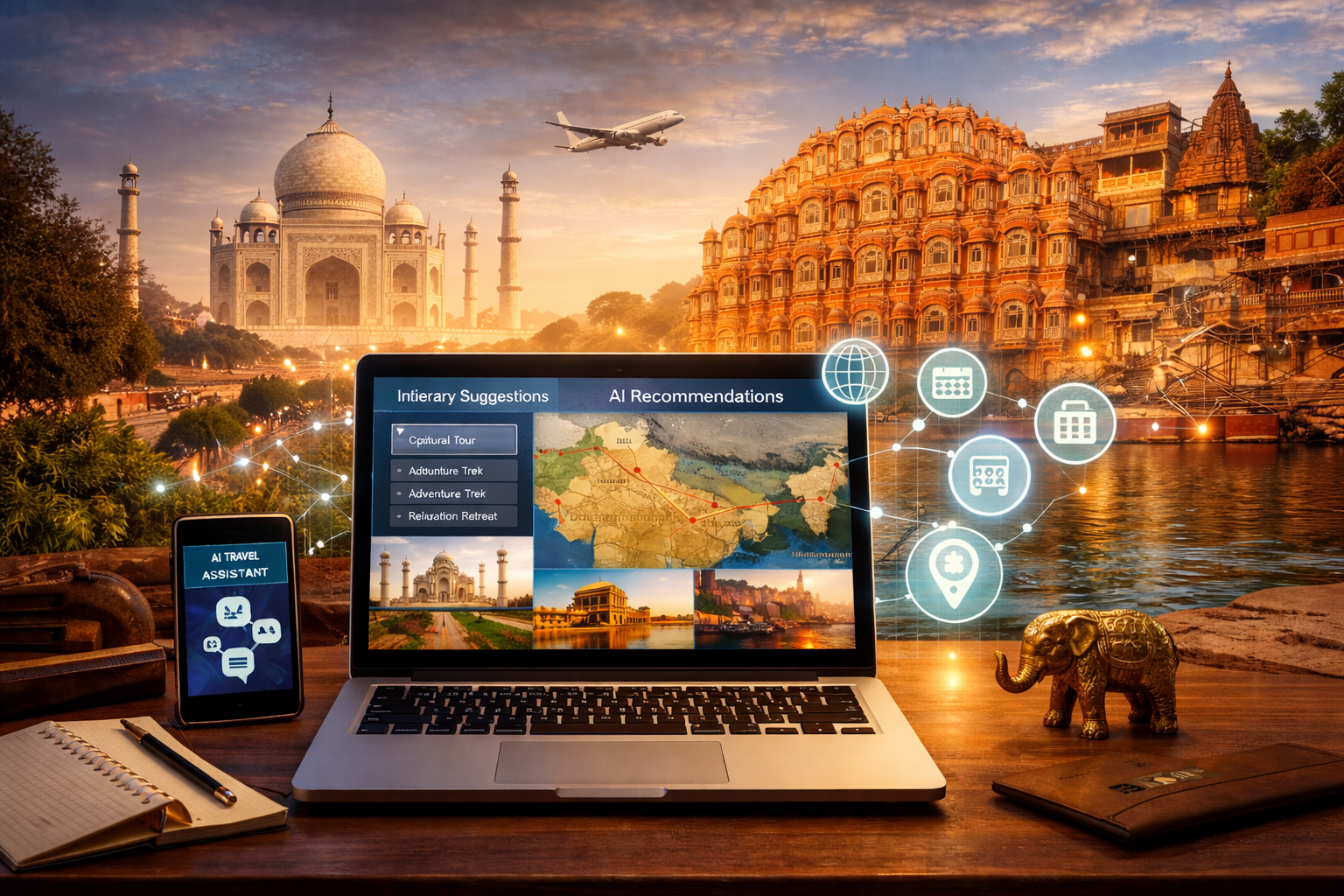
Can AI Plan Luxury Travel? Where Technology Ends, and Human Creation Begins

215, Qutab Plaza, DLF Phase 1, Gurugram, Haryana - 122002, India
contact@travelscopeindia.com
+91 124 499 9499